
Download the graphic presentation: 14.05.2026 Sondaj INSCOP Relația României cu Republica Moldova
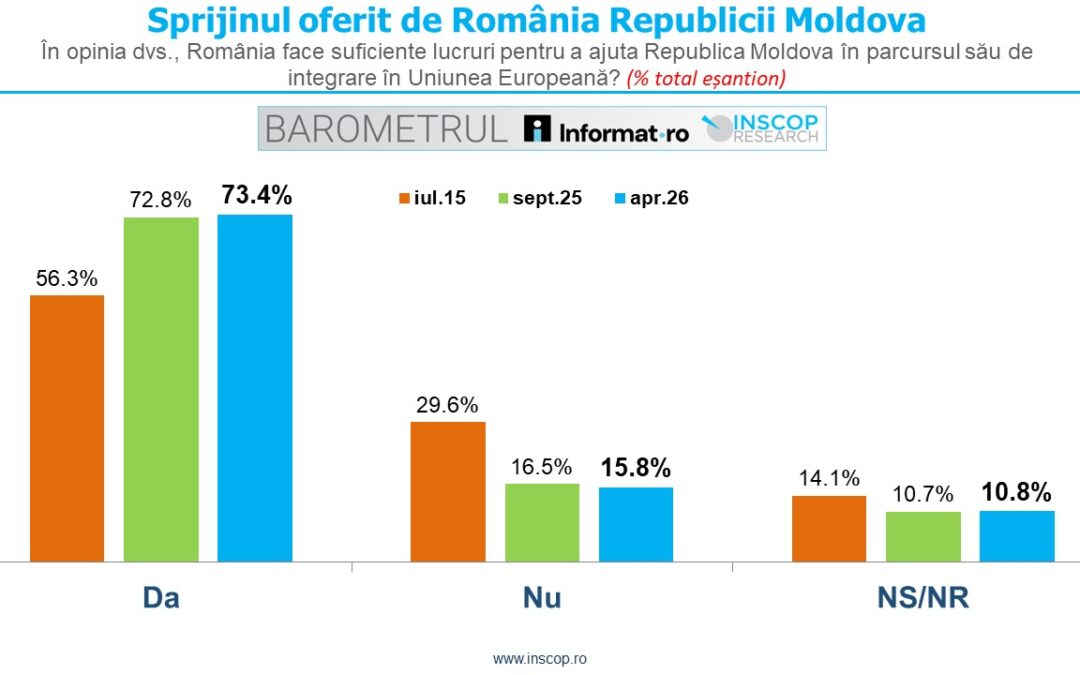
One of the conclusions of the survey “Romanians’ Perception of the Republic of Moldova”, conducted by INSCOP Research between April 14–21 2026, is that 3 out of 4 Romanians believe that Romania is doing enough to support the Republic of Moldova in its path toward European Union integration.
Methodology: The data for the survey “Romanian’s Perception of the Republic of Moldova” were collected between April14–21 2026, using the CATI method (telephone interviews). The sample consisted of 1,100 respondents, selected through a simple random sampling procedure, and is representative of the non-institutionalized population of Romania aged 18 and over, across key socio-demographic categories (gender, age, occupation). The maximum margin of error is ±3%, at a 95% confidence level.
Support Provided by Romania to the Republic of Moldova
73.4% of respondents believe that Romania is doing enough to support the Republic of Moldova in its path toward European Union integration (compared to 56.3% in July 2015 and 72.8% in September 2025), while 15.8% think it is not doing enough (compared to 29.6% in July 2015 and 16.5% in September 2025). The share of non-responses is 10.8% (compared to 14.1% in July 2015 and 10.7% in September 2025).
PSD and AUR voters, people over 60, and rural residents are more likely than the general population to believe that Romania is doing enough to support Moldova’s EU integration.
By contrast, individuals under 44 and residents of large urban areas are significantly more likely than the rest of the population to believe that Romania is not doing enough for Moldova’s EU integration.
European Integration of the Republic of Moldova
47.1% of respondents (compared to 40.5% in July 2015) agree with the statement: “The European integration of the Republic of Moldova depends more on the support of Romania and other European states”, while 44.1% (compared to 46% in July 2015) choose the statement: “The European integration of the Republic of Moldova depends more on the will of its citizens and politicians to pursue this path”. 8.8% do not know or did not answer (compared to 13.5% in July 2015).
AUR voters, individuals aged 45–59, and those with primary education report in higher-than-average proportions to believe that Moldova’s EU integration depends primarily on external support from Romania and other European countries.
On the other hand, PNL and USR voters, individuals over 60, those with higher education, and residents of Bucharest are more likely than the rest of the population to believe that Moldova’s EU integration depends mainly on the will of its own citizens and political leadership.
Evolution of the Romania – Republic of Moldova Relationship
50.7% of respondents believe that the relationship between Romania and the Republic of Moldova has improved in recent years, 16.3% think it has worsened, and 25.2% believe it has remained the same. The share of non-responses is 7.9%.
Those who believe that relations have improved are more likely than average to be PNL and USR voters, individuals over 60, people with higher education, residents of large urban areas, and public sector employees.
AUR voters, individuals aged 30–44, those with primary education, and rural residents are more likely than general population to believe that relations between the two countries have worsened.
Those who believe that the relationship has remained unchanged are more likely than the rest of the population to be AUR voters, young people under 30, individuals with medium education, and residents of small urban areas.
Download the graphic presentation: 14.05.2026 Sondaj INSCOP Relația României cu Republica Moldova
