
Download the graphic presentation: 22.07.26 Barometrul Informat.ro-Inscop Research – Tipul de regim preferat
One of the key conclusions of the 13th edition of the Informat.ro – INSCOP Research Barometer is that Romanian society is divided between supporters of democracy – even at the cost of political conflict and debate – and those who would accept a less democratic regime in exchange for order and stability.
The Informat.ro – INSCOP Research BAROMETER is a monthly opinion poll conducted by INSCOP Research at the request of the news platform Informat.ro, in partnership with the Strategic Thinking Group think tank.
The Informat.ro – INSCOP Research BAROMETER aims to bring to public attention topics of interest to stimulate national conversations on diverse subjects and key public policies for Romania’s present and future, based on citizen’s opinions, in partnership with prestigious think tanks and academic institutions. It is an initiative intended to contribute to strengthening democracy by using scientific and credible tools that place citizen’s voices at the center of public debate.
Methodology: Data were collected between July 13-16 2026. Research method: questionnaire-based interviews. Data were collected using the CATI method (telephone interviews). The simple random sample included 1,100 respondents and is representative of the significant sociodemographic categories (gender, age, occupation) for Romania’s non-institutionalized population aged 18 and older. The maximum margin of error is ±2.95% at a 95% confidence level.
Remus Ștefureac, director of INSCOP Research: “The results of the Informat.ro – INSCOP Barometer indicate a worrying level of weakening attachment to democratic values. Although the current context—marked by political instability, economic difficulties, and declining trust—inevitably shapes public perceptions, the fact that nearly half of Romanians believe that a less democratic regime may be preferable if it ensures order and stability goes beyond mere situational dissatisfaction. At the same time, the majority continues to support democratic control of power, even at the cost of slower decision-making, which shows that democratic principles still retain an important base of legitimacy. The tension between these two attitudes reflects a vulnerable democratic culture, in which a significant part of society is willing to relativize democratic norms when they perceive that these no longer provide order, efficiency, and stability, or when distrust in the fairness of elections persists among important segments of the population. The evolution of these indicators over time will be essential to distinguish between the temporary effects of the current crisis and a potential structural deterioration of attachment to democracy. Younger people tend to support democracy to a greater extent, while AUR voters, individuals with primary education, and rural residents are more likely to prefer a less democratic regime that ensures greater order and stability.”
Preferred type of democratic regime
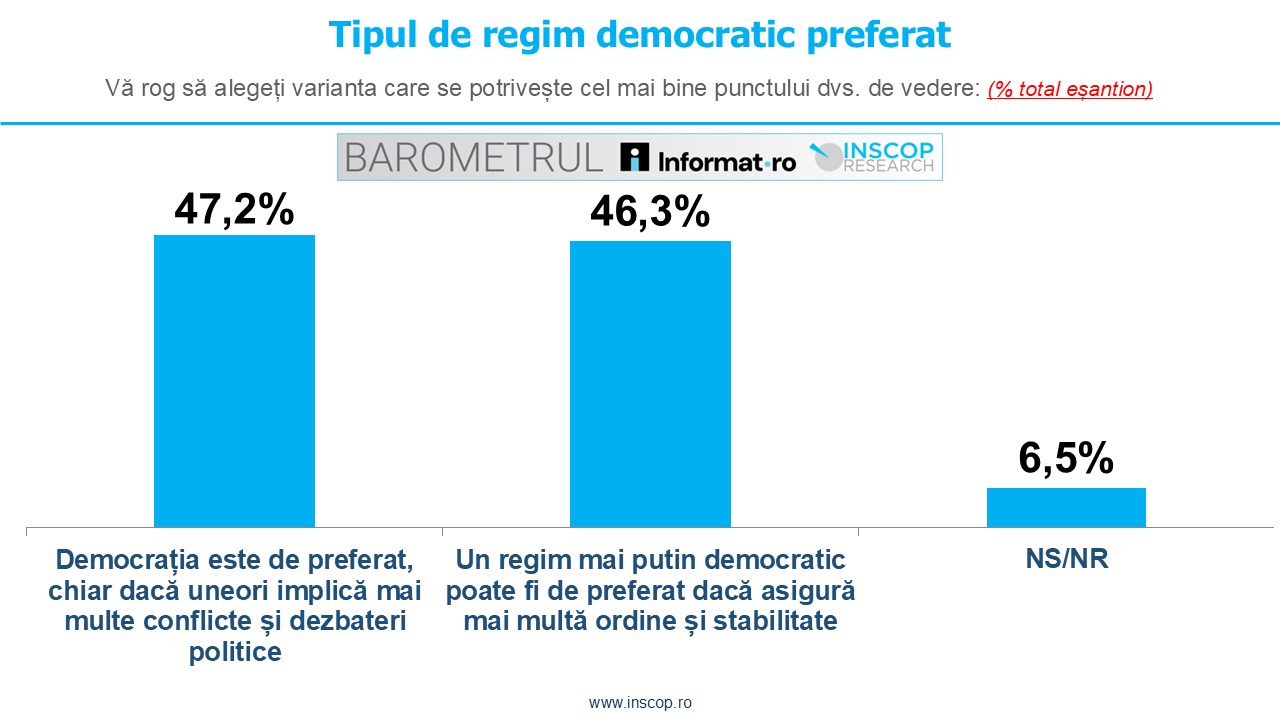
47.2% of survey participants believe that democracy is preferable, even if it sometimes involves more political conflict and debate, while 46.3% believe that a less democratic regime may be preferable if it ensures more order and stability. 6.5% do not know or did not answer.
PNL and USR voters, men, young people under 30, individuals with higher education, and residents of large urban areas are significantly more likely than average to prefer democracy. AUR voters, individuals aged 45–59, those with primary education, and rural residents are more likely than average to prefer a less democratic regime because it ensures more order and stability.
Agreement with statements
60.6% of respondents believe that it is more important for power to be democratically controlled, even if decisions are made more slowly. By contrast, 29.5% believe that it is more important for decisions to be made quickly, even if democratic control over power is reduced. The share of non-responses is 9.8%.
PNL and USR voters, individuals aged 45–59, those with higher education, and residents of Bucharest and large urban areas are more likely than average to say that democratic control of power is more important. AUR voters, individuals aged 30–44, those with primary education, and rural residents are significantly more likely than average to believe that it is more important for decisions to be made quickly.
Download the graphic presentation: 22.07.26 Barometrul Informat.ro-Inscop Research – Tipul de regim preferat
