
Download the graphic presentation: 12.05.2026 Sondaj INSCOP Relațiile României cu alte țări
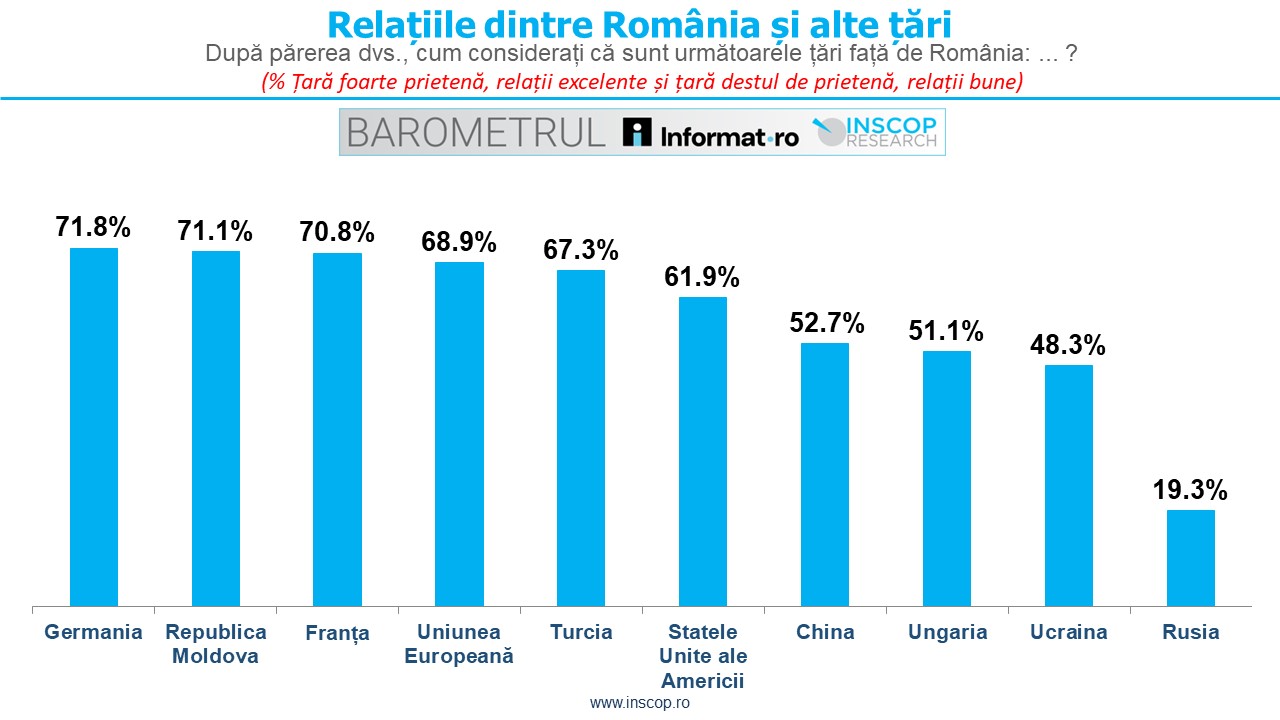
Germany ranks first among countries perceived as friendly (very friendly and somewhat friendly), followed by the Republic of Moldova and France, according to the survey “Romanian’s Perception of the Republic of Moldova”, conducted as part of the Informat.ro Barometer – INSCOP Research, 10th edition.
The Informat.ro – INSCOP Research BAROMETER is a monthly opinion poll conducted by INSCOP Research at the request of the news platform Informat.ro, in partnership with the Strategic Thinking Group think tank.
The Informat.ro – INSCOP Research BAROMETER aims to bring to public attention topics of interest to stimulate national conversations on diverse subjects and key public policies for Romania’s present and future, based on citizen’s opinions, in partnership with prestigious think tanks and academic institutions. It is an initiative intended to contribute to strengthening democracy by using scientific and credible tools that place citizen’s voices at the center of public debate.
Methodology: The data for the survey “Romanian’s Perception of the Republic of Moldova” were collected between April14–21 2026, using the CATI method (telephone interviews). The sample consisted of 1,100 respondents, selected through a simple random sampling procedure, and is representative of the non-institutionalized population of Romania aged 18 and over, across key socio-demographic categories (gender, age, occupation). The maximum margin of error is ±3%, at a 95% confidence level.
Remus Ștefureac, director of INSCOP Research: “The Republic of Moldova is perceived by Romanians more as a closely related identity space than as a typical foreign state. The level of trust and sympathy for Chișinău is very high, comparable to that granted to major Western countries, indicating that the relationship goes beyond geopolitical logic and enters the realm of cultural and historical ties. Skepticism toward Moldova is concentrated among AUR voters. The West remains Romania’s main strategic anchor. Germany, France, and the European Union continue to inspire strong trust, but increasingly clear differences are emerging between more educated, urban, pro-European segments and the more Eurosceptic AUR electorate. Even in this case, however, the share of pro-European AUR voters is higher than that of Eurosceptics. The United States maintains significant strategic capital, although somewhat lower among USR voters. Ukraine represents the largest opinion divide within Romanian society. Perceptions are almost evenly split between support and hostility, indicating that the nearby war is being filtered through cognitive warfare and propaganda. Younger people, PNL and USR voters, and those with higher education are significantly more favorable toward Ukraine, while AUR voters and more conservative or economically vulnerable segments show stronger reluctance. Finally, Russia remains the external actor facing the strongest rejection in Romanian society, a sign that distrust toward this country continues to dominate. However, the data indicate the existence of a core of tolerance or relative sympathy concentrated among AUR voters, rural populations, and individuals with lower levels of education. This trend suggests a higher vulnerability of these groups to disinformation and propaganda. Still, only one-third of AUR voters sympathize with Russia, compared to two-thirds who consider it an unfriendly country.”
Romania’s relations with other countries
In the ranking of countries perceived as friendly to Romania (very friendly and somewhat friendly), Germany ranks first with 71.8%, followed by the Republic of Moldova with 71.1%, France with 70.8%, and the European Union with 68.9%. The ranking continues with Turkey (67.3%), the United States (61.9%), and China (52.7%). At the bottom of the ranking are Hungary (51.1%), Ukraine (48.3%), and Russia (19.3%).
Germany
71.8% of Romanians consider Germany a friendly country. 17.9% of respondents view Germany as very friendly, with excellent relations, while 53.9% consider it somewhat friendly, with good relations. 15.2% believe Germany is not very friendly, with somewhat tense relations, and 8.6% see it as not friendly at all, with very cold and tense relations. 4.4% did not know or did not answer.
PNL and USR voters, men, young people under 30, and individuals with higher education are more likely than average to consider Germany a friendly country.
PSD and AUR voters, women, people over 60, and those with primary education are more likely than average to believe that Germany is not a friendly country toward Romania.
Republic of Moldova
71.1% of Romanians consider the Republic of Moldova a friendly country. 26.8% of respondents see it as very friendly, with excellent relations with Romania, while 44.3% consider it somewhat friendly, with good relations. 11.5% believe it is not very friendly, with somewhat tense relations, and 12% see it as not friendly at all, with very cold and tense relations. 5.4% did not know or did not answer.
PSD, PNL, and USR voters, young people under 30, and individuals with higher education are more likely than average to consider the Republic of Moldova a friendly country.
AUR voters, individuals aged 45–59, those with primary education, and public sector employees are more likely than average to believe that the Republic of Moldova is not a friendly country toward Romania.
France
70.8% of Romanians consider France a friendly country. 23.3% of respondents view France as very friendly, with excellent relations with Romania, while 47.5% see it as somewhat friendly, with good relations. 12.6% believe France is not very friendly, with somewhat tense relations, and 12% consider it not friendly at all, with very cold and tense relations. 4.6% do not know or did not answer.
PNL and USR voters, young people under 30, individuals with higher education, residents of large urban areas, and private sector employees are more likely than average to consider France a friendly country.
AUR voters, individuals aged 30–44, those with primary education, and public sector employees are more likely than average to believe that France is not a friendly country toward Romania.
European Union
68.9% of Romanians consider the European Union a friendly entity. 24.7% believe the European Union is very friendly, with excellent relations with Romania, while 43.9% consider it somewhat friendly, with good relations. 14.6% see it as not very friendly, with somewhat tense relations, and 12.4% as not friendly at all, with very cold and tense relations. 4.4% do not know or did not answer.
PNL and USR voters, individuals aged 18–44, those with higher education, residents of Bucharest and large urban areas, and private sector employees are more likely than average to view relations with the EU as positive.
AUR voters, people over 60, those with primary education, residents of small urban areas, and public sector employees are more likely than average to consider the relationship with the EU tense.
Turkey
67.3% of Romanians consider Turkey a friendly country. 13.3% of respondents view Turkey as very friendly, with excellent relations, while 54.1% consider it somewhat friendly, with good relations. 13.3% see it as not very friendly, with somewhat tense relations, and 9.8% as not friendly at all, with very cold and tense relations. The share of non-responses is 9.5%.
PSD and USR voters, young people under 30, individuals with higher education, and residents of large urban areas are more likely than average to consider Turkey a friendly country.
PNL and AUR voters, individuals aged 30–44, and those with primary education are more likely than average to believe that Turkey is not a friendly country.
United States of America
61.9% of Romanians consider the United States a friendly country. 14.9% of respondents see the United States as very friendly, with excellent relations with Romania, while 47% perceive it as somewhat friendly, with good relations. 21.5% believe the United States is not very friendly, with somewhat tense relations, and 10% consider it not friendly at all, with very cold and tense relations. 6.6% do not know or did not answer.
PSD and PNL voters, as well as people over 60, are more likely than average to consider the United States a friendly country.
USR voters, individuals aged 45–59, and residents of Bucharest and large urban areas are more likely than average to view the United States as not very or not at all friendly.
China
52.7% of Romanians consider China a friendly country. 7% of respondents view China as very friendly, with excellent relations with Romania, while 45.7% consider it somewhat friendly, with good relations. 21.1% see it as not very friendly, with somewhat tense relations, and 15% as not friendly at all, with very cold and tense relations. The share of non-responses is 11.1%.
PSD voters, people over 60, individuals with higher education, and residents of small urban areas are more likely than average to consider China a friendly country.
Individuals aged 18–44 and residents of large urban areas are more likely than average to believe that China is not a friendly country.
Hungary
51.1% of Romanians consider Hungary a friendly country. 5.5% view Hungary as very friendly, with excellent relations with Romania, while 45.6% consider it somewhat friendly, with good relations. 27.7% believe it is not very friendly, with somewhat tense relations, and 15% consider it not friendly at all, with very cold and tense relations. 6.3% do not know or did not answer.
USR voters, young people under 30, individuals with higher education, and public sector employees are more likely than average to consider Hungary a friendly country.
Individuals aged 45–59 and residents of Bucharest are more likely than average to believe that Hungary is not a friendly country.
Ukraine
48.3% of Romanians consider Ukraine a friendly country. 11.4% of respondents view Ukraine as very friendly, with excellent relations with Romania, while 36.9% consider it somewhat friendly, with good relations. 22% believe it is not very friendly, with somewhat tense relations, and 24.9% consider it not friendly at all, with very cold and tense relations. 4.8% do not know or did not answer.
PNL and USR voters, young people under 30, individuals with higher education, and residents of Bucharest are more likely than average to consider Ukraine a friendly country.
AUR voters, individuals aged 45–59, those with primary and medium education, and public sector employees are more likely than average to believe that Ukraine is not a friendly country toward Romania.
Russia
19.3% of Romanians consider Russia a friendly country. 3.9% of respondents view relations with Russia as excellent, considering it a very friendly country, while 15.3% see it as somewhat friendly, with good relations. 29.9% believe Russia is not very friendly, with somewhat tense relations, and 45.6% consider it not friendly at all, with very cold and tense relations. The share of non-responses is 5.3%.
AUR voters, young people under 30, and rural residents are more likely than average to consider Russia a friendly country.
PNL and USR voters, individuals with higher education, and residents of Bucharest and large urban areas are more likely than average to believe that Russia is not a friendly country toward Romania.
Download the graphic presentation: 12.05.2026 Sondaj INSCOP Relațiile României cu alte țări
