
Download the graphic presentation: 11.05.2026 Sondaj Inscop – Activitatea Maiei Sandu
According to the survey “Romanian’s Perceptions of the Republic of Moldova,” conducted as part of the “Informat.ro – INSCOP Research Barometer” project (10th edition), two-thirds of Romanians have a favorable opinion of Maia Sandu’s work.
The Informat.ro – INSCOP Research BAROMETER is a monthly opinion poll conducted by INSCOP Research at the request of the news platform Informat.ro, in partnership with the Strategic Thinking Group think tank.
The Informat.ro – INSCOP Research BAROMETER aims to bring to public attention topics of interest to stimulate national conversations on diverse subjects and key public policies for Romania’s present and future, based on citizen’s opinions, in partnership with prestigious think tanks and academic institutions. It is an initiative intended to contribute to strengthening democracy by using scientific and credible tools that place citizen’s voices at the center of public debate.
Methodology: The data for the survey “Romanian’s Perception of the Republic of Moldova” were collected between April14–21 2026, using the CATI method (telephone interviews). The sample consisted of 1,100 respondents, selected through a simple random sampling procedure, and is representative of the non-institutionalized population of Romania aged 18 and over, across key socio-demographic categories (gender, age, occupation). The maximum margin of error is ±3%, at a 95% confidence level.
Remus Ștefureac, director of INSCOP Research: “The data indicate that Maia Sandu has a positive public image in Romania, built mainly on her association with the pro-European direction and with closeness to Bucharest. The very clear perception that Maia Sandu is closer to Romania and not to Russia shows that the image of the President of the Republic of Moldova is becoming, in the eyes of a solid majority of Romanians, synonymous with the idea of breaking away from Russian influence and of firmly anchoring in the European and Western space. However, the differences between political electorates and social categories show that perceptions of Maia Sandu are also, in part, an indicator of internal polarization in Romania. The more pro-European and urban segments overwhelmingly support her, while the AUR electorate is significantly more reserved amid hostile narratives promoted by the party’s leaders. Thus, the evaluation of Maia Sandu functions as a litmus test of how different segments of Romanian society relate to the West, Russia, and the strategic direction of the region.”
Maia Sandu’s activity
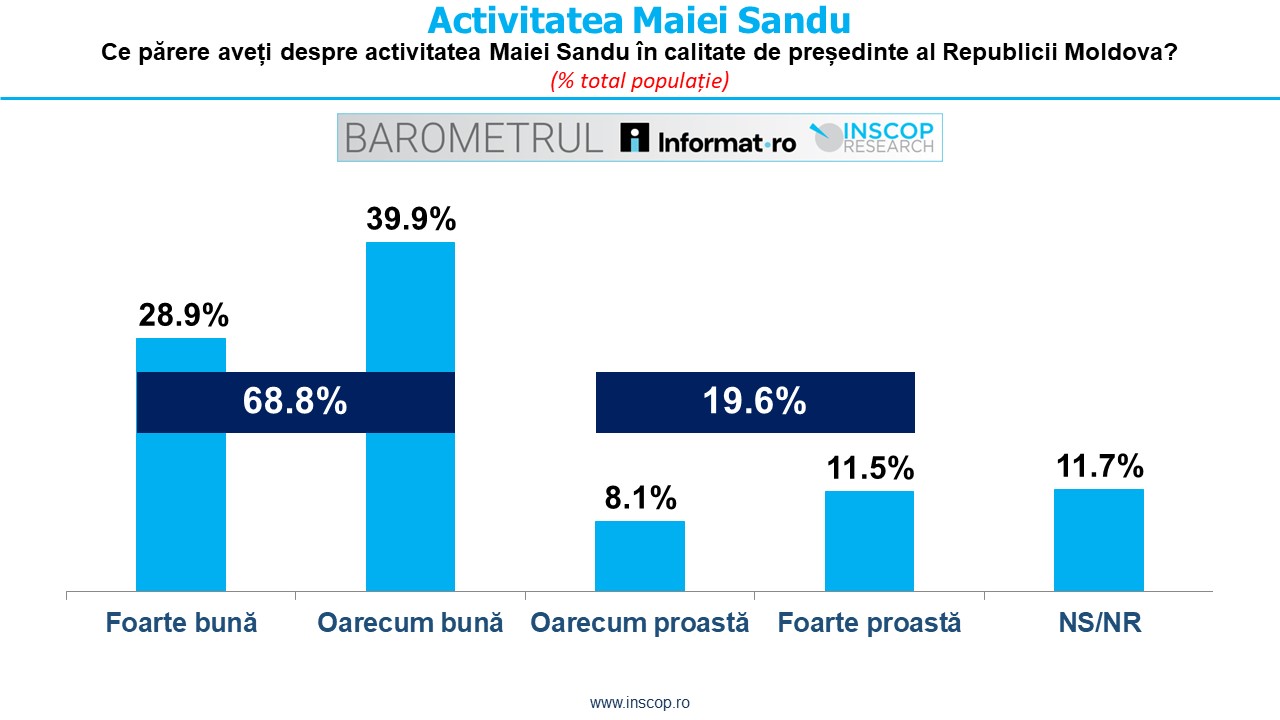
68.8% of Romanians have a very good and somewhat good opinion of Maia Sandu’s activity as President of the Republic of Moldova (28.9% of respondents have a very good opinion, while 39.9% have a somewhat good opinion). 8.1% have a somewhat bad opinion, and 11.5% a very bad opinion. 11.7% do not know or did not answer.
PSD, PNL, and USR voters, people with higher education, and residents of small urban areas have a good opinion of Maia Sandu’s activity at a higher rate than average.
AUR voters and people with primary education have a worse opinion of the President of the Republic of Moldova compared to the rest of the population.
Maia Sandu’s relationship with Romania vs. Russia
71.3% of respondents say that the statement “Maia Sandu is closer to Romania than to Russia” best reflects their opinion, while 14.3% choose the statement “Maia Sandu is closer to Russia than to Romania.” 14.3% do not know or did not answer.
PNL and USR voters, people over 60, those with higher education, and residents of small urban areas believe at a higher rate than average that Maia Sandu is closer to Romania than to Russia.
AUR voters, people aged 30–44, and those with primary education are the most likely to believe that Maia Sandu is closer to Russia than to Romania.
Maia Sandu’s contribution to closer Romania–Republic of Moldova relations
57.5% of Romanians believe that Maia Sandu contributes to strengthening the relationship between Romania and the Republic of Moldova to a very large or fairly large extent (21% of respondents believe she contributes to a very large extent, while 36.5% to a fairly large extent). 15.1% believe she contributes to a fairly small extent, while 18.2% think she contributes very little or not at all. The share of non-responses is 9.1%.
PSD, PNL, and USR voters, people aged 30–44, those with higher education, and residents of Bucharest and large urban areas believe at a higher rate than average that Maia Sandu contributes significantly to strengthening relations between Romania and the Republic of Moldova.
AUR voters, people aged 45–59, and those with primary education are more likely than the rest of the population to believe that Maia Sandu contributes little or not at all to strengthening relations between the two neighboring countries.
Download the graphic presentation: 11.05.2026 Sondaj Inscop – Activitatea Maiei Sandu
