
Download the graphic presentation: 08.05.2026 Sondaj INSCOP Impactul Unirii cu Republica Moldova asupra României
According to the survey “Romanian’s Perception of the Republic of Moldova”, conducted as part of the Informat.ro Barometer – INSCOP Research, 10th edition, nearly two-thirds of Romanians believe that a potential unification with the Republic of Moldova would make Romania a stronger country.
The Informat.ro – INSCOP Research BAROMETER is a monthly opinion poll conducted by INSCOP Research at the request of the news platform Informat.ro, in partnership with the Strategic Thinking Group think tank.
The Informat.ro – INSCOP Research BAROMETER aims to bring to public attention topics of interest to stimulate national conversations on diverse subjects and key public policies for Romania’s present and future, based on citizen’s opinions, in partnership with prestigious think tanks and academic institutions. It is an initiative intended to contribute to strengthening democracy by using scientific and credible tools that place citizen’s voices at the center of public debate.
Methodology: The data for the survey “Romanian’s Perception of the Republic of Moldova” were collected between April14–21 2026, using the CATI method (telephone interviews). The sample consisted of 1,100 respondents, selected through a simple random sampling procedure, and is representative of the non-institutionalized population of Romania aged 18 and over, across key socio-demographic categories (gender, age, occupation). The maximum margin of error is ±3%, at a 95% confidence level.
Remus Ștefureac, director of INSCOP Research: “The data from the Informat.ro – INSCOP Barometer suggest that Romanians view unification with the Republic of Moldova primarily through a logic of national consolidation rather than cost. The dominant perception is that Romania would become stronger, indicating that the topic of unification is mainly associated with the idea of expanding the country’s influence, regional relevance, and geopolitical weight. The public tends to interpret unification more as a strategic investment than as an administrative burden. At the same time, on economic and security dimensions, Romanian society appears more divided and cautious. There is also a significant difference between types of electorate and social categories: younger, urban, and more educated segments tend to view unification through a strategic and European lens, while economically more vulnerable groups or those more exposed to subversive political narratives are more likely to project risks and costs. This divide suggests that the future of the unification issue will depend less on historical arguments and more on the ability of political elites to build a credible narrative around security, development, and economic integration.”
Impact of Unification with the Republic of Moldova on Romania (I): A stronger country vs. a weaker country
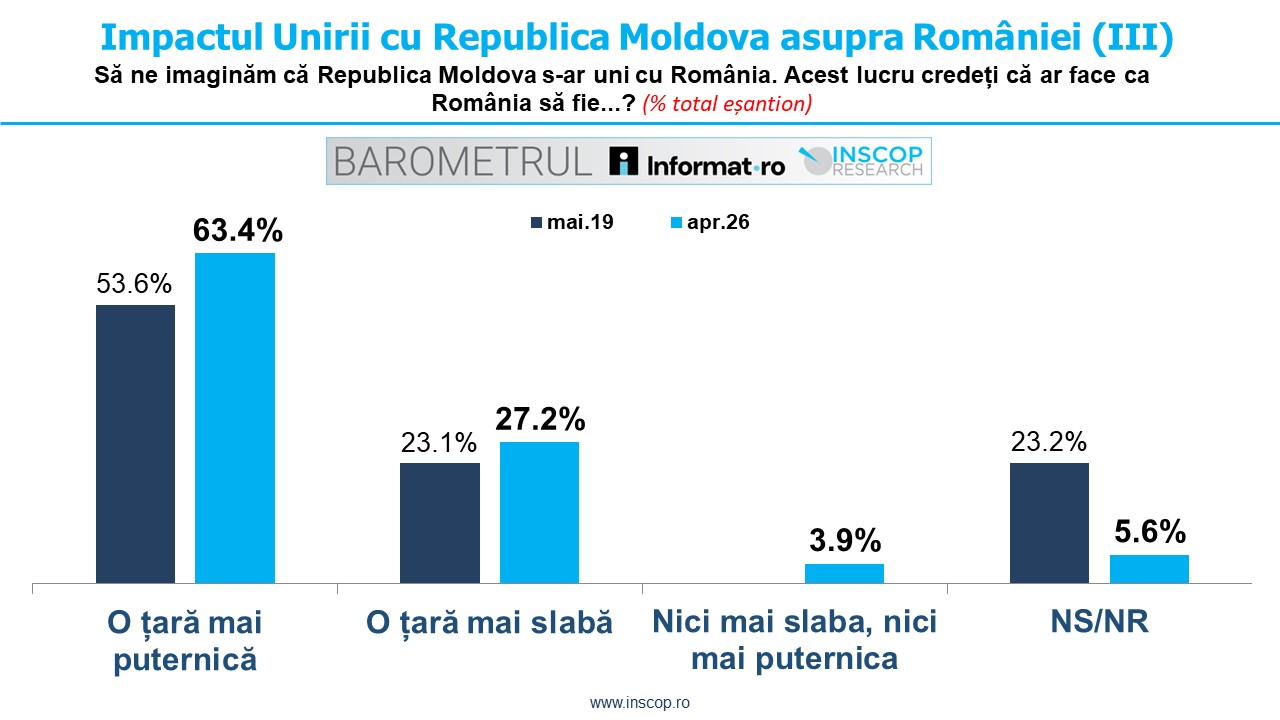
63.4% of respondents believe that unification with the Republic of Moldova would make Romania a stronger country (compared to 53.6% in May 2019). 27.2% believe it would become a weaker country (compared to 23.1% in May 2019), 3.9% think it would be neither weaker nor stronger, and 5.6% do not know or did not answer (compared to 23.2% in May 2019).
PNL and USR voters, as well as young people under 30, are more likely than the general population to believe that unification would make Romania stronger.
Impact of Unification with the Republic of Moldova on Romania (II): A safer country vs. a less safe country
Asked how unification with the Republic of Moldova would affect national security, 50.4% of Romanians believe that Romania would become safer, while 37.4% think it would become less safe. 3.7% believe it would be neither safer nor less safe, and 8.5% do not know or did not answer.
PNL and USR voters, young people under 30, individuals with medium education, and residents of large urban areas are more likely than average to believe that unification would make Romania safer.
AUR voters, individuals with higher education, and public sector employees are more likely than average to believe that Romania would become less safe following unification.
AUR voters and individuals aged 45–59 are more likely than average to believe that unification would make Romania weaker.
Impact of Unification with the Republic of Moldova on Romania (III): A richer country vs. a poorer country
49.5% of respondents believe that unification with the Republic of Moldova would make Romania a richer country. 32.2% believe Romania would become poorer, while 8.4% think it would be neither richer nor poorer. The share of non-responses is 9.9%.
PNL and USR voters, young people under 30, residents of large urban areas, and private sector employees are more likely than average to believe that unification would make Romania richer.
AUR voters and rural residents are more likely than average to believe that unification would make Romania poorer.
USR voters and individuals aged 45–59 are more likely than average to believe that unification would make Romania neither richer nor poorer.
Download the graphic presentation: 08.05.2026 Sondaj INSCOP Impactul Unirii cu Republica Moldova asupra României
