
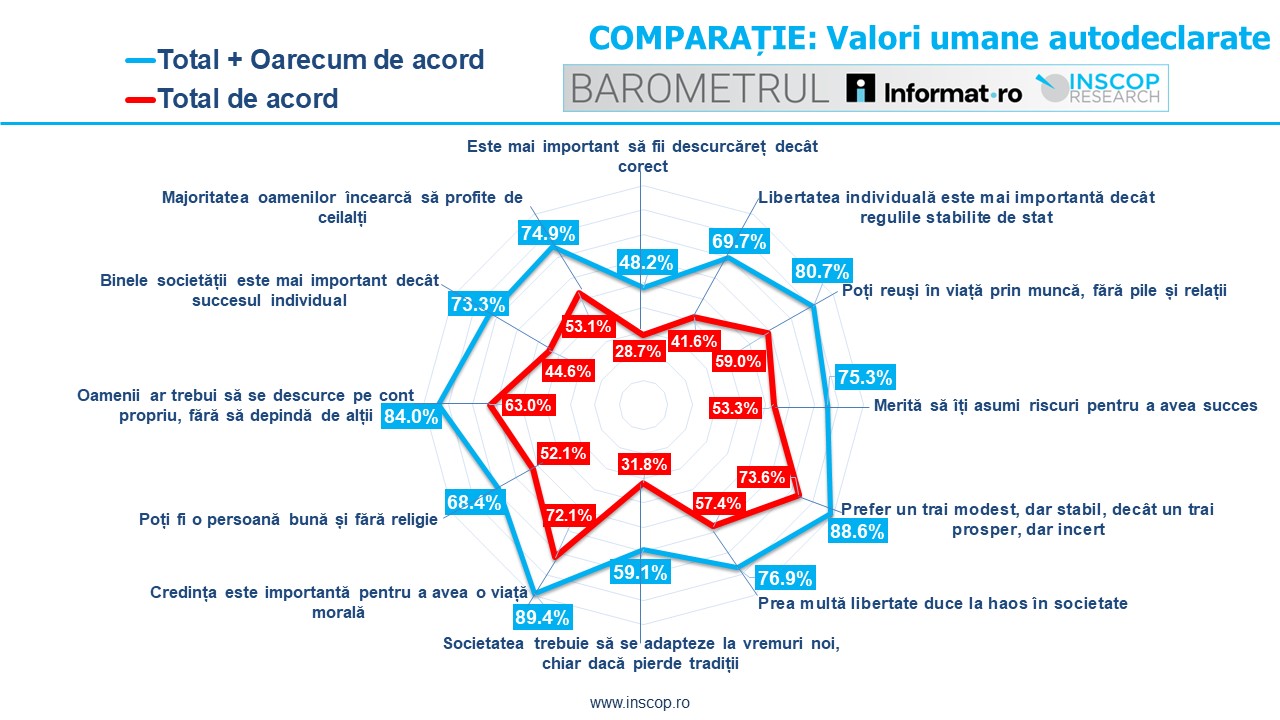
Download the graphic presentation: 30.04.2026 Barometru Informat.ro – Inscop – Valori sociale
The Informat.ro – INSCOP Research BAROMETER is a monthly opinion poll conducted by INSCOP Research at the request of the news platform Informat.ro, in partnership with the Strategic Thinking Group think tank.
The Informat.ro – INSCOP Research BAROMETER aims to bring to public attention topics of interest to stimulate national conversations on diverse subjects and key public policies for Romania’s present and future, based on citizen’s opinions, in partnership with prestigious think tanks and academic institutions. It is an initiative intended to contribute to strengthening democracy by using scientific and credible tools that place citizen’s voices at the center of public debate.
Methodology: Data were collected between April 1–7, 2026. Research method: questionnaire-based interviews. Data were collected using the CATI method (telephone interviews). The simple random sample included 1,100 respondents and is representative of the significant sociodemographic categories (gender, age, occupation) for Romania’s non-institutionalized population aged 18 and older. The maximum margin of error is ±3% at a 95% confidence level.
Human values in Romanian society
The study tested Romanians’ opinions regarding 12 values described through a series of statements, toward which survey participants could express total or partial agreement, or total or partial disagreement.
Ranking of human values by total or partial agreement
- Faith is important for living a moral life – 89.4%
- I prefer a modest but stable life over a prosperous but uncertain one – 88.6%
- People should manage on their own without depending on others – 84.0%
- You can succeed in life through hard work, without connections – 80.7%
- Too much freedom leads to chaos in society – 76.9%
- It is worth taking risks in order to succeed – 75.3%
- Most people try to take advantage of others – 74.9%
- The good of society is more important than individual success – 73.3%
- Individual freedom is more important than rules set by the state – 69.7%
- You can be a good person without religion – 68.4%
- Society must adapt to new times, even if it loses traditions – 59.1%
- It is more important to be resourceful than honest – 48.2%
Ranking of human values by total agreement (high intensity)
- I prefer a modest but stable life over a prosperous but uncertain one – 73.6%
- Faith is important for living a moral life – 72.1%
- People should manage on their own without depending on others – 63.0%
- You can succeed in life through hard work, without connections – 59.0%
- Too much freedom leads to chaos in society – 57.4%
- It is worth taking risks in order to succeed – 53.3%
- Most people try to take advantage of others – 53.1%
- You can be a good person without religion – 52.1%
- The good of society is more important than individual success – 44.6%
- Individual freedom is more important than rules set by the state – 41.6%
- Society must adapt to new times, even if it loses traditions – 31.8%
- It is more important to be resourceful than honest – 28.7%
Main conclusions of the research “Human values in Romanian society”
A society perceived as materialistic, but with different moral aspirations
Romanians describe society as dominated by money and status, but their own responses indicate a clear aspiration toward morality, work, and fairness. This reflects a typical divide in low-trust societies between negative perceptions of others and a positive self-image.
Stability is the dominant latent value
Beyond explicit responses, there is a strong preference for security, predictability, and risk avoidance. Romania appears as a defensive rather than aspirational society.
Pragmatic, not ideological individualism
Support exists for personal autonomy, but it reflects necessity rather than liberal conviction—people rely on themselves because the system is perceived as unreliable.
The freedom vs. order tension remains unresolved
Romanians simultaneously support individual freedom and the idea that too much freedom leads to chaos, indicating ambivalence and openness to restrictive measures justified by stability.
Meritocracy is aspirational, not experiential
Most believe success can come through work, yet this coexists with perceptions of widespread opportunism and “getting by,” suggesting an idealized meritocracy not strongly supported by lived experience.
Religion remains a symbolic but not exclusive pillar
Faith is strongly associated with morality, but there is also acceptance that morality can exist without religion, pointing to a shift toward cultural rather than strictly normative religiosity.
Conditional acceptance of modernization
There is openness to change, but also resistance when it involves losing traditions—indicating a conservative, negotiated model of modernization.
High level of generalized social distrust
The belief that most people try to take advantage of others signals low social capital, helping explain risk aversion and preference for stability.
Electoral differences are about intensity, not direction
Value hierarchies are broadly similar across electorates, with variations in emphasis rather than fundamental differences.
The real divide is socio-demographic: education and age
Younger and more educated individuals show greater openness, risk tolerance, and autonomy, while older and less educated groups prefer stability and order. There is also a clear divide between large urban areas and rural environments.
Five value typologies identified
- Defensive traditionalists – prioritize stability, order, religion, and resist change
- Survival pragmatists – rely on adaptability and “getting by” in a perceived unfair system
- Aspirational individualists – believe in merit, accept risk, and support change
- Moral communitarians – emphasize collective good and social balance
- Ambivalent moderates – hold mixed, sometimes contradictory values and adapt contextually
Dominant values in Romanian society
48.7% of respondents believe that in today’s Romania people value money and status the most. 20.4% mention family and relationships, 9.5% stability, 9.4% faith and traditions, and 8.7% personal freedom. The share of non-responses is 3.4%.
USR voters, young people under 30, individuals with higher education, and public sector employees are the most likely to believe that money and status are the dominant values in today’s Romanian society. AUR voters and those with primary education indicate, to a greater extent than the average, that family and relationships are the dominant value.
Agreement with statements: Human values
“It is more important to be resourceful than honest”
Asked to what extent they agree with the statement “It is more important to be resourceful than honest,” 28.7% of respondents say they totally agree, 19.5% somewhat agree, 11.2% somewhat disagree, and 38.3% totally disagree. 2.3% do not know or did not answer.
Agreement is higher than average among AUR and PSD voters, young people under 30, and individuals with primary education. Opposition is higher than average among PNL and USR voters, people aged 45–59, those with higher education, residents of Bucharest and large urban areas, and public sector employees.
“Individual freedom is more important than rules set by the state”
41.6% of respondents totally agree with the statement “Individual freedom is more important than rules set by the state,” while 28.1% somewhat agree. 10.2% somewhat disagree and 14.9% totally disagree. Non-responses account for 5.2%.
Agreement is higher than average among PSD and AUR voters, young people under 30, and individuals with medium education. Opposition is higher than average among USR voters, those with higher education, and residents of the capital.
“You can succeed in life through hard work, without connections”
59% of respondents totally agree with the statement “You can succeed in life through hard work, without connections.” 21.7% somewhat agree, 6.3% somewhat disagree, and 11.9% totally disagree. 1.1% do not know or did not answer.
Agreement is higher than average among USR and AUR voters, people aged 30–44, those with primary education, and private sector employees. Opposition is higher than average among PSD voters, people over 60, and public sector employees.
“It is worth taking risks in order to succeed”
Asked to what extent they agree with the statement “It is worth taking risks in order to succeed,” 53.3% say they totally agree, 22% somewhat agree, 6.3% somewhat disagree, and 16% totally disagree. Non-responses account for 2.4%.
Agreement is higher than average among USR voters, men, individuals aged 18–44, those with higher education, and residents of Bucharest. Opposition is higher than average among PSD and PNL voters, women, people over 45, those with primary or medium education, and rural residents.
“I prefer a modest but stable life over a prosperous but uncertain one”
73.6% of respondents totally agree with the statement “I prefer a modest but stable life over a prosperous but uncertain one,” while 15% somewhat agree. 2.9% somewhat disagree and 7% totally disagree. 1.5% do not know or did not answer.
People over 60 are more likely than average to agree with this statement. Opposition is higher among USR voters, young people under 30, and those with primary education.
“Too much freedom leads to chaos in society”
57.4% of respondents totally agree with the statement “Too much freedom leads to chaos in society.” 19.5% somewhat agree, 6.5% somewhat disagree, and 12.9% totally disagree. Non-responses account for 3.7%.
Agreement is higher than average among PNL voters and women. Opposition is higher among USR voters, men, those with higher education, and private sector employees.
“Society must adapt to new times, even if it loses traditions”
31.8% totally agree with the statement “Society must adapt to new times, even if it loses traditions,” while 27.3% somewhat agree. 10.3% somewhat disagree and 28% totally disagree. 2.6% do not know or did not answer.
Agreement is higher among PNL and USR voters, young people under 30, individuals with higher education, and residents of Bucharest. Opposition is higher among PSD voters and people over 60.
“Faith is important for living a moral life”
72.1% of respondents totally agree with the statement “Faith is important for living a moral life,” while 17.3% somewhat agree. 4% somewhat disagree and 5.7% totally disagree. Non-responses account for 0.9%.
Agreement is higher among AUR voters. Opposition is higher among USR voters, young people under 30, those with higher education, and residents of Bucharest.
“You can be a good person without religion”
52.1% totally agree with the statement “You can be a good person without religion.” 16.3% somewhat agree, 5.4% somewhat disagree, and 24.4% totally disagree. 1.9% do not know or did not answer.
Agreement is higher among PNL and USR voters, men, young people under 30, individuals aged 45–59, those with higher education, residents of Bucharest, and private sector employees. Opposition is higher among PSD voters, women, people over 60, those with primary education, and rural residents.
“People should manage on their own without depending on others”
63% of respondents totally agree with the statement “People should manage on their own without depending on others,” while 21% somewhat agree. 5.8% somewhat disagree and 8% totally disagree. Non-responses account for 2.2%.
Agreement is higher among AUR voters. Opposition is higher among PNL voters, young people under 30, and those with higher education.
“The good of society is more important than individual success”
44.6% totally agree with the statement “The good of society is more important than individual success,” while 28.7% somewhat agree. 8.6% somewhat disagree and 13.8% totally disagree. 4.4% do not know or did not answer.
Agreement is higher among USR voters and men. Opposition is higher among people aged 18–44 and those with higher education.
“Most people try to take advantage of others”
53.1% totally agree with the statement “Most people try to take advantage of others.” 21.8% somewhat agree, 6.1% somewhat disagree, and 17.1% totally disagree. Non-responses account for 1.9%.
Agreement is higher among young people under 30, individuals with medium education, residents of large urban areas, and public sector employees. Opposition is higher among PSD voters, individuals with primary education, and rural residents.
Download the graphic presentation: 30.04.2026 Barometru Informat.ro – Inscop – Valori sociale
